What Are the Stages of Group Therapy? A Guide for Therapists
Group therapy rarely starts with depth on day one. Even when members are motivated and the structure is thoughtful, groups need time to become groups.
That is part of what makes group work so meaningful. A therapy group is not just a collection of individuals receiving support side by side. It is a living relational system that develops over time. Members begin by looking for safety, then gradually test trust, navigate difference, build connection, and, if the group is supported well, use those relationships to do deeper therapeutic work.
For therapists, understanding group process and development can make the work feel more grounded. It helps explain why early sessions may feel cautious, why tension often shows up before cohesion does, why the middle phase can feel especially alive, and why endings deserve real clinical attention. It also gives facilitators a useful framework for pacing interventions, naming what is happening in the room, and responding with more confidence rather than reacting moment to moment.
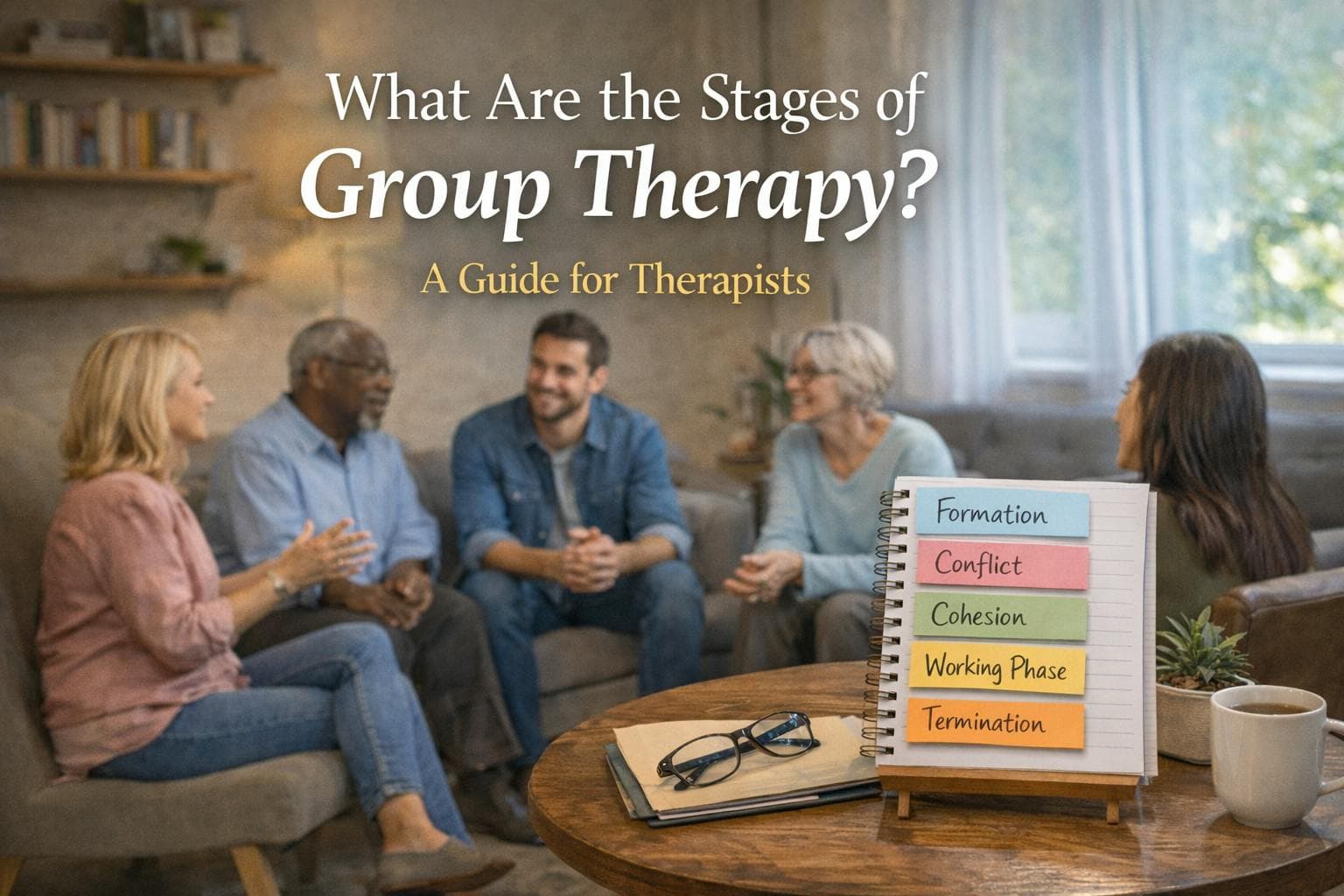
While different writers use slightly different language, the classic developmental arc of groups is often understood as: formation, conflict, cohesion, working phase, and termination. These stages are not always perfectly linear, and some groups may move back and forth between them. Still, they offer a practical map for therapists leading groups in real settings.
1. Formation and orientation
In the beginning stage, members are usually asking some version of the same question: Is it safe to be here?
That early uncertainty often shows up as politeness, hesitancy, over-explaining, guarded sharing, or a strong reliance on the facilitator. Members may want connection, but still feel unsure about how much to reveal, how the group will respond, or whether they truly belong. As SAMHSA’s guidance on group development explains, the first phase of a group centers on orientation, engagement, and building the safety needed for therapeutic work.
This stage matters because the group cannot move into meaningful depth without a strong container. That means therapists often need to be especially active at the start: setting expectations, clarifying the purpose of the group, naming confidentiality and its limits, outlining norms for participation, and helping members understand what group therapy asks of them. The American Group Psychotherapy Association’s practice guidelines also emphasize the value of preparation, structure, and informed consent in helping groups get off to a strong start.
For many therapists, this is also the stage where good planning outside the room pays off inside the room. Screening, member fit, and clarity about the frame all shape how secure a group feels early on. That is one reason thoughtful setup matters so much in group work.
2. Conflict and differentiation
Once the group begins to settle, differences start to emerge.
This is the phase where members may test boundaries, react to one another’s styles, challenge the facilitator, compete for space, withdraw, or feel disappointed when the group does not immediately feel deeply connected. In broader team-development language, this is often called “storming,” but in therapy groups it is often better understood as a stage of conflict and differentiation. Members are becoming more real to each other, and real relationships include friction.
That friction is not automatically a problem. In fact, it is often a sign that the group is moving past surface-level relating. The challenge is not to eliminate tension altogether, but to help the group stay connected enough to work with it. As SAMHSA notes, groups in the early and middle phases need support managing hostility and difference in ways that protect the treatment frame while still allowing honest expression.
This is often where group process becomes easier to see. Who pulls back when conflict appears? Who becomes overly accommodating? Who moves into advice instead of emotional contact? Who feels left out? Who takes up space when anxious? These are not side issues. They are often central to the work.
This phase can also be especially important for therapists who are co-facilitating a group. A strong co-facilitation partnership can make it easier to track both the emotional tone of the room and the subtle interpersonal dynamics unfolding between members.
3. Cohesion and norming
When a group moves through tension without shutting down, something important begins to build: cohesion.
Members usually become more comfortable with one another, more willing to speak directly, and more open to both giving and receiving feedback. The group starts to feel less like a room of separate individuals and more like a shared therapeutic space. Norms become clearer. Members know what kind of honesty is possible there.
This stage matters because cohesion is not just a pleasant byproduct of group therapy. It is one of the most important ingredients in whether a group helps. A meta-analysis on cohesion in group therapy found a significant relationship between group cohesion and positive treatment outcomes, reinforcing the long-standing clinical understanding that members do better when they feel meaningfully connected to the group and invested in its process.
Still, healthy cohesion is not the same as constant comfort. Groups can become overly polite, overly leader-dependent, or subtly resistant to difference. Real cohesion has enough strength to make room for disagreement, repair, and complexity. It allows people to stay connected without collapsing into sameness.
This is often where therapists can help the group lean more fully into interpersonal learning. Instead of rescuing every difficult moment, facilitators can support curiosity, reflection, and direct engagement. Over time, the group itself starts to carry more of the therapeutic work.
4. The working phase
The working phase is where the group often feels most alive.
By this point, members are more capable of emotional risk, more willing to be seen, and more able to use the group as a place to explore recurring relational patterns in real time. The therapist may still guide the structure, but the group usually begins responding to itself with more depth and less dependence on the leader.
This phase is where content and process come together. A member may talk about feeling unseen in a marriage, but the deeper clinical opportunity may be how that same experience is unfolding in the room. Another may say they want closeness, while repeatedly staying guarded with the group. Group therapy becomes especially powerful when these patterns can be noticed, named, and explored in relationship rather than only discussed in the abstract.
Recent group psychotherapy research continues to highlight the value of group treatment not only for symptom relief, but also for belonging, hope, interpersonal learning, and meaning-making. That is part of what makes this phase so rich. The group is no longer just a setting for therapy. It becomes part of the therapy itself.
This is also where the structure of the group matters. Some groups are designed to continue over time, while others are intentionally brief or contained around a particular format. Therapists thinking through that distinction may find it helpful to explore the essential differences between short-term and ongoing psychodynamic group therapy or review time-limited group therapy formats for practice.
5. Termination and ending well
All therapy groups end. Strong groups do not simply stop — they terminate with intention.
Endings often bring a mix of gratitude, grief, reflection, pride, avoidance, and unfinished feelings. Members may revisit familiar relational themes around separation, loss, or visibility. Therapists sometimes underestimate how clinically meaningful this phase can be, but endings often reveal just how much the group has come to matter.
According to SAMHSA’s stage-based guidance, the ending phase includes helping members review what they have learned, recognize progress, and prepare for the transition out of the group. That kind of closing work can help members integrate the experience rather than leave it behind too quickly.
A thoughtful ending gives members space to name what they are taking with them, what has shifted, what still feels unfinished, and how they want to say goodbye. In many cases, the quality of the ending becomes part of the therapy.
Why understanding group stages matters
For therapists, understanding the stages of group therapy can make group leadership feel clearer and more intentional.
It helps normalize why first sessions often feel tentative. It explains why conflict may be part of progress rather than evidence that something is wrong. It sheds light on why cohesion matters so much, and why the middle phase of a group often carries the deepest opportunities for change. It also reminds facilitators that ending well is part of good treatment, not an afterthought.
Just as importantly, this framework gives therapists a central lens through which many other group topics make more sense. How conflict unfolds, how cohesion develops, how first sessions are structured, how groups end, and how facilitators share leadership are all easier to understand when seen through the lens of development over time.
Group therapy is relational work, and relationships unfold in stages. When therapists know how to recognize those stages, they are better able to guide the group with steadiness, flexibility, and care.
For therapists building or refining a group practice, understanding group development is not just theory. It is part of what helps a group become a place where meaningful healing can actually happen.
Sources
- SAMHSA / NCBI Bookshelf: Substance Abuse Treatment: Group Therapy — Group Development and Phase-Specific Tasks
- American Group Psychotherapy Association: Practice Guidelines for Group Psychotherapy
- PubMed: Cohesion in Group Therapy: A Meta-Analysis
- PMC: New Horizons in Group Psychotherapy Research and Practice