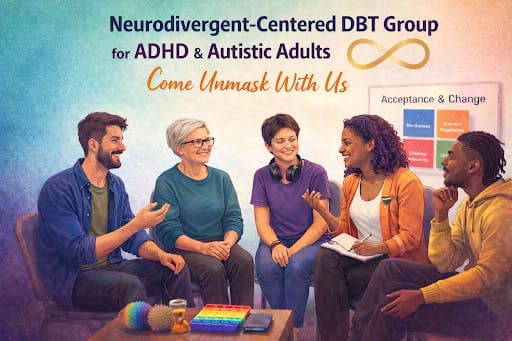
In-person Neurodivergent-Centered DBT for ADHD & Autistic Adults in NYC:Come Unmask With Us
Do you feel overstimulated, isolated, or constantly on the verge of shutdown? Do social interactions leave you depleted? Does it ever feel like everyone else got a social rule book you never received?
Many autistic and ADHD adults describe living in constant survival mode, masking traits that are core parts of who they are. This can be exhausting, harm self-esteem, and lead to burnout.
If you are searching for neurodivergent-affirming therapy in New York City, this in-person neurodivergent-centered DBT group in NYC group was created for you.
The Cost of Masking and Autistic Burnout
Many neurodivergent adults become experts at masking: consciously or unconsciously camouflaging autistic or ADHD traits to appear more socially acceptable. Research links prolonged masking in autistic adults to increased anxiety, depression, and emotional exhaustion (Hull et al., 2017; Cage & Troxell-Whitman, 2019).
Over time, masking and chronic overstimulation can lead to:
- Sensory overload
- Emotional dysregulation
- Meltdowns or shutdowns
- Social burnout
- Internalized stigma
- Isolation and loneliness
A neurodivergent-centered DBT approach recognizes these patterns rather than pathologizing them.
What I often hear:
“I’m tired of being made to feel that there’s something wrong with me.” “I need coping skills that actually work for my brain.” "I want to feel pride in who I am instead of shame.”
Is DBT Effective for ADHD and Autism?
Dialectical Behavior Therapy (DBT), developed by Marsha Linehan (1993), has strong empirical support for improving emotional regulation, distress tolerance, and interpersonal functioning.
Emerging research suggests that structured, CBT- and DBT-informed skills-based group interventions may benefit adults with ADHD and autistic traits (Hirvikoski et al., 2011). While research specific to DBT adaptations for neurodivergent adults is still developing, findings indicate that clear, structured skills training can be especially effective when adapted for sensory and executive functioning differences.
For many neurodivergent adults, DBT skills provide structure, predictability, and practical tools for navigating intense emotions. In addition, the group therapy space allows for neurodivergent adults to connect with people who naturally understand, practice unmasking, and build self-compassion. Many group members describe this group as a tight-knit supportive community space which has become a home to many.
Why Traditional DBT May Miss Neurodivergent Needs
Standard DBT includes four modules:
- Mindfulness
- Distress tolerance
- Emotion regulation
- Interpersonal effectiveness
However, traditional DBT was not designed with sensory processing differences, difficulty with change, masking, or autistic burnout at the center.
For example:
- A meltdown is not simply “anger.”
- Shutdown is not laziness.
- Sensory overload is not emotional immaturity.
- Avoiding eye contact is not interpersonal failure.
A neurodivergent-centered DBT group integrates emotional regulation with sensory awareness, masking fatigue, and an understanding of what it means to live as a neurodivergent person in a world made for neurotypicals.
What Makes This Neurodivergent-Centered DBT Group Different?
The neurodiversity paradigm reframes neurotypes such as autism and ADHD as natural cognitive variations, rather than disorders to eliminate, while also acknowledging that individuals may experience disability within environments not designed for them. This philosophy informs neurodivergent-affirming care.
In this DBT group for autistic and ADHD adults, we focus on:
- Understanding and accepting your neurodivergent traits
- Sensory regulation skills that reduce overload
- Recognizing signs of meltdown, shutdown, and burnout
- Learning to unmask safely and authentically
- Navigating social situations without abandoning yourself
- Building self-advocacy
- Cultivating neurodivergent pride
Some things that make the group more neurodivergent-friendly
- Stimming is welcome and sensory items are provided (though you are welcome to bring your own!)
- Lighting is low and warm
- Group structure is clear and expectable
- You are welcome to step into the quiet lobby at any time to take a break
- Time is given to process questions, no one is ever forced to speak
- Questions are direct prompts rather than abstract reflections
- Doodling on paper is welcome
- Reading written responses (rather than speaking freely) is always welcome
This is not about “fixing” you. It is about helping you carve out a place for yourself in a world that was not built for you. We utilize a workbook written by a neurodivergent therapist who has modified skills to make them more relevant to neurodivergent people.
Neurodiversity, LGBTQIA+ Identity, and Pride
I specialize in working at the intersection of neurodivergence and LGBTQIA+ identities. Many neurodivergent adults also identify as queer or gender-expansive identities and have experienced oppression and pride on multiple axes.
In this therapy group, neurodivergent and LGBTQIA+ identities are centered as meaningful aspects of who you are.
Together, we:
- Deconstruct stigma
- Acknowledge the reality of oppression
- Explore internalized shame
- Strengthen self-advocacy
- Build lives aligned with your values
DBT becomes more than coping skills — it becomes a framework for self-acceptance and agency!
You Don’t Need a Formal Autism Diagnosis
Many autistic adults are self-identified or late-diagnosed. You do not need official paperwork to explore neurodivergent-affirming therapy.
This in-person DBT group in NYC may be a fit if you are:
- An adult (18+) identifying as autistic or ADHD
- Verbally fluent and able to participate independently. At this time, collaboration with families is not available. Participants must be able to manage their own communication and attendance.
- Already working with an individual therapist or psychiatrist
- LGBTQIA+ identified, or able to be respectful in predominantly LGBTQIA+ spaces
- Seeking an in-person neurodivergent-centered therapy group in New York City
What to Expect in This NYC DBT Group
This is a structured, 2-hour, in-person DBT group in NYC focused on skills, discussion, and neurodivergent community building.
Group details:
- In-person in Chelsea, Manhattan
- Thursdays, 4:30–6:30 PM
- Skills-based and discussion-oriented
- LGBTQIA+-affirming
- Community-focused
We begin at 4:30 with discussion of skills, take a short break around 5:30, then begin structured checkins, wherein participants have an opportunity to share what is going on in their day-to-day lives and get support from others who can relate.
You deserve therapy that respects your identity, your brain, and your lived experience. Sliding scale options based on need and availability.
Have questions? Let’s talk about whether this neurodivergent-centered DBT group is the right fit.
About the Author

Liliana Valvano, LMSW, is a Licensed Master Social Worker, therapist, and researcher specializing in neurodiversity and LGBTQIA+ identities. Her work centers on deconstructing stigma and helping clients build lives worth living through self-acceptance and self-advocacy. She has worked extensively within LGBTQIA+ and disability communities and views membership in these communities as a privilege rather than a burden. Her approach integrates research-informed frameworks with an intersectional, affirming lens to support neurodivergent adults in thriving, not just coping.
References
Linehan, M. M. (1993). Cognitive-Behavioral Treatment of Borderline Personality Disorder. Guilford Press. https://www.guilford.com/books/Cognitive-Behavioral-Treatment-of-Borderline-Personality-Disorder/Marsha-Linehan/9780898621834
Hull, L., Petrides, K. V., Allison, C., Smith, P., Baron-Cohen, S., Lai, M. C., & Mandy, W. (2017). “Putting on My Best Normal”: Social camouflaging in adults with autism spectrum conditions. Journal of Autism and Developmental Disorders, 47(8), 2519–2534. https://pubmed.ncbi.nlm.nih.gov/28527095 You can also read the full open-access text here: https://pmc.ncbi.nlm.nih.gov/articles/PMC5509825/
Cage, E., & Troxell-Whitman, Z. (2019). Understanding the reasons, contexts and costs of camouflaging for autistic adults. Journal of Autism and Developmental Disorders, 49, 1899–1911. https://pubmed.ncbi.nlm.nih.gov/30627892/ You can also view the open-access version here: https://pmc.ncbi.nlm.nih.gov/articles/PMC6483965/
Hirvikoski, T., Waaler, E., Lindström, T., Bölte, S., & Jokinen, J. (2011). Cognitive behavioral therapy-based group intervention for adults with ADHD and autism spectrum disorders: A pilot study. European Psychiatry, 26(7), 464–469. https://pubmed.ncbi.nlm.nih.gov/21295767/