When Men Really Show Up For Each Other
A Guide to Men's Interpersonal Process Group Therapy
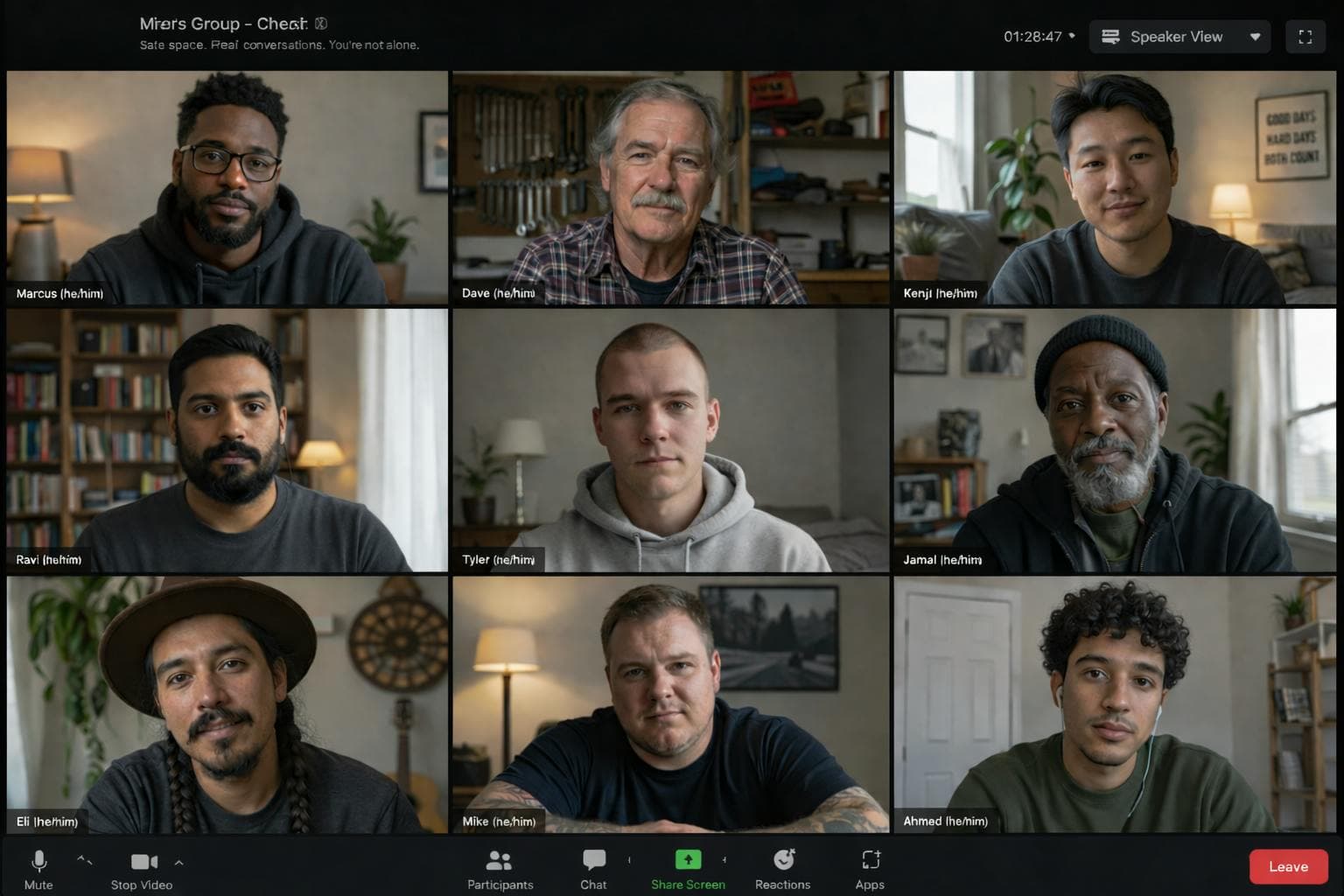
Most men have been handed a script. It starts early — at home, on the playground, in locker rooms — and by adulthood, our masculine induction is so ingrained it long ago became subconscious.
"Grow a pair. Man up. Walk it off. Suck it up. Don't be a wuss. Get over it."
Not just words. This is our social training from a very young age: feelings are a liability, vulnerability is weakness, asking for help is unthinkable. The result is a set of masks — the provider, the fixer, the high performer, the guy who's fine, the joker — formed in our family of origin and reinforced by everything that follows. Underneath: men who've been trained out of their own inner lives, sometimes so effectively they grow more disconnected from themselves and those closest to them.
Men's interpersonal process group therapy is designed to work directly with that. Not around it.
1: What Is a Men's Interpersonal Process Group?
Individual therapy can be deeply valuable — but some things only become visible in relationship with other people. That's where interpersonal process group becomes something individual work alone can't replicate.
It's not a support group, a curriculum, or a place to trade advice. It's a small, therapist-led group centered on what happens between people in real time. The core idea is deceptively simple: when you say something, I notice what it brings up in me — and I say that out loud. Not "wow, that's rough." Not "have you tried..." But genuine present-moment contact:
“Juan, when I heard you say that, I felt something land on my chest. It reminded me of a time I felt both helpless and furious — and I didn't know what to do with either one.”
2: Who Benefits from a Men’s Process Group — and What You Can Gain
Men who have spent years learning to function without ever really learning how to relate. Men who know how to perform, provide, achieve, or endure — but not how to stay emotionally present or let themselves be known.
This group tends to be a strong fit for men who:
- Feel disconnected — from partners, friends, or themselves — and can't quite name why
- Feel lonely even when surrounded by people
- Feel pressure to always appear "fine," "strong," or self-sufficient
- Are navigating grief, loss, or major life transitions
- Struggle with emotional intimacy or keeping relationships close
- Grew up in families where conflict was avoided, explosive, or never resolved
- Don't know the difference between assertiveness and aggression
- Are ready to move beyond individual therapy into relational work
Over time, members typically find that they:
- Build the capacity to stay present instead of shutting down or withdrawing
- Reduce isolation and develop stronger connections with men who genuinely understand
- Experience more fulfilling relationships — with partners, friends, and themselves
- Process grief, loss, and major transitions in a supportive, honest environment
- Learn the difference between assertiveness and aggression — and communicate more effectively
- Practice real-time relationship skills in a live, dynamic group environment
3: Common Themes Men Explore in Group
This group does not follow a fixed agenda — what emerges is shaped organically by what participants bring in real time. At the same time, the work is grounded in clear therapeutic goals: building self-awareness, improving relationships, and developing the capacity to stay present in connection with others.
Common themes that arise include grief and loss that hasn't been fully processed, repeated relationship patterns, questions of identity and masculinity, and shame — the persistent, exhausting sense of not being enough. Conflict is also a central area of focus. Many men grew up in environments where conflict was either avoided entirely or handled badly. This group offers something rare: a safe space to engage conflict directly, stay present through it, and work toward more constructive ways of relating — a kind of relational do-over.
4: What to Expect in a Men’s Therapy Group
The group meets every week. No agenda. No topic. No structure imposed from the outside. It's treated as a self-organizing system that takes on a life of its own — shaped by whoever is in the room and what emerges between them.
When someone takes a risk — say, Juan reveals something vulnerable — the instinctive male responses tend to show up fast: empathy at a distance ("man, that's rough"), advice-giving ("why don't you just..."), cheerleading ("you've got this"), or outright dismissing ("that's dumb; get over it"). These responses, however well-intentioned, are often the same behaviors that minimize and shut a person down — managing the listener's discomfort rather than staying present with the speaker.
What the group works toward instead is harder and more meaningful. The most powerful moment in this scenario is Juan finding his own voice:
"I just put something real out there and nobody responded. I'm hurt. I want to shut down. I feel angry."
That is self-advocacy in practice, and assertive vs. aggressive — skills the group actively cultivates. Sometimes it's something the therapist has already introduced and members are learning to apply. Other times, the moment emerges spontaneously, and the therapist names it in real time, inviting members to notice their own reactions: Is silence typical for you when someone takes a risk? What happened in you when Juan spoke up? That inquiry becomes the relational learning. When one man practices it, every other man in the room gets permission to do the same — and the group opens into something most of these men have never experienced before.
“This is a space for men to discover hidden aspects of themselves — including vulnerability and shame — and to witness and learn to express feelings while staying grounded and connected to the men around them.”
5: Is This Group Right for You?
You don't have to be struggling in obvious ways to benefit from this work. Many of the men who get the most out of this group are high-functioning, self-sufficient, outwardly successful — and privately aware that something is missing. If any of these questions have crossed your mind, this group may be worth exploring:
- Despite everything I have and have achieved, why do I still feel empty or "not enough"?
- Why do I keep ending up in the same kinds of relationships?
- Why do I feel lonely even when I'm around people?
- Why do I shut down, hold everything in, or just go through the motions?
- Why do I want deeper connection but struggle to let people in?
These aren't rhetorical questions: They are both workable and answerable in a men's interpersonal process group, in the presence of other men asking them too.
The masks we wear are heavy — not because we're weak, but because we've carried them so long, they no longer feel like masks. They feel like faces. In this group, sometimes for the first time, men get to be seen without them. And what becomes possible after that tends to surprise even the most skeptical men in the room.
Jeff’s men’s process group is now accepting new members. If something here resonated—or raised a question—a free consultation is the right next step. The current California based men's therapy group meets virtually every Monday from 6:30–8:00 PM PT. If this time doesn’t work for you but you’d like to be part of this kind of space, I’m happy to add you to a waitlist for future options

About the Author
Jeff Kleinberg, Ph.D. MFT is a licensed therapist in California and the founder of Suddenly Normal Psychotherapy, Inc. He specializes in individual and group therapy, both for adults, with a particular focus on men's relational and interpersonal work. Jeff's men's interpersonal process group has been a cornerstone of his practice — a space grounded in psychodynamic principles, present-moment awareness, and the belief that genuine connection between men is both possible and transformative. He offers online therapy exclusively, serving clients throughout California.